
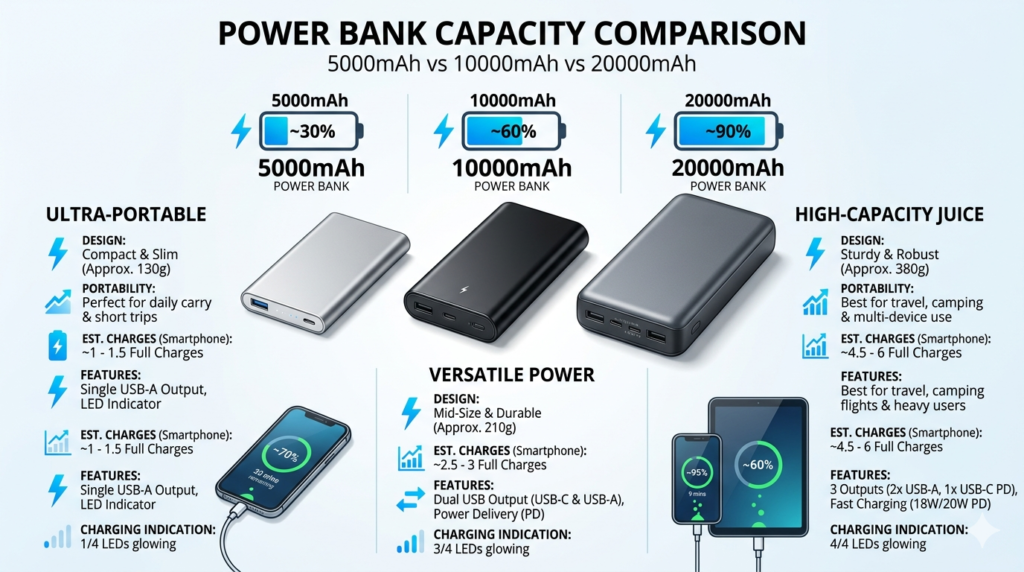

Power Bank Capacity Explained (mAh Guide) – What Size Power Bank Do You Really Need?
Buying a power bank sounds simple until you start looking at the specifications.
You will see numbers like 5000mAh, 10000mAh, 20000mAh, and sometimes even larger capacities. For many buyers, these numbers can be confusing. Does a bigger number always mean a better power bank? How many times will it charge your phone? And which capacity is actually right for your needs?
If you have ever asked these questions, you’re not alone.
In this guide, we’ll explain what mAh means, how power bank capacity works, and how to choose the right size for your daily use.
What Does mAh Mean?
The term mAh stands for milliampere-hour.
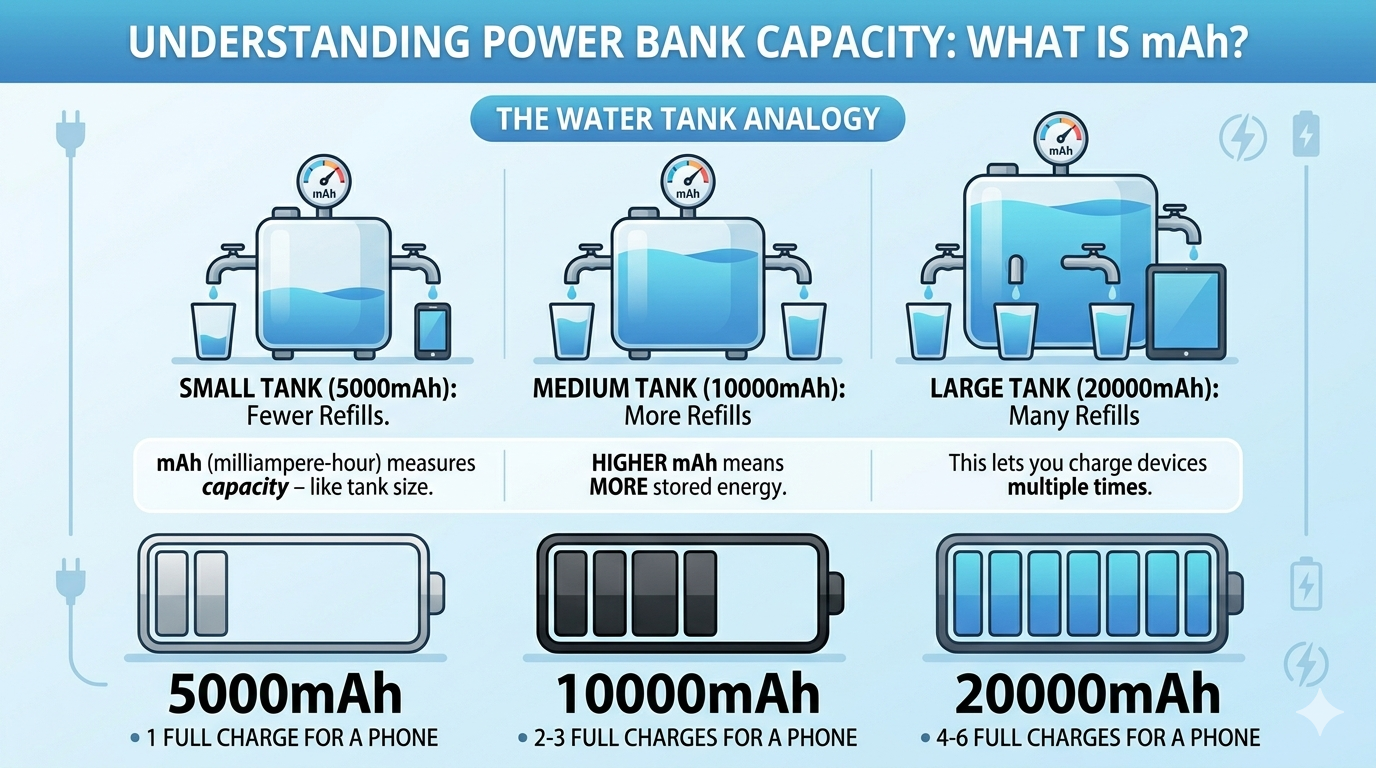
In simple words, it measures how much energy a battery can store. The higher the mAh rating, the more power the battery can hold.
Think of it like a water tank.
A small tank holds less water, while a larger tank stores more. Similarly, a 20000mAh power bank stores more energy than a 10000mAh power bank.
However, bigger is not always better. The right choice depends on how you use your devices.
Why Power Bank Capacity Matters
Capacity directly affects how many times a power bank can charge your phone before it needs to be recharged.
For example:
- 5000mAh power bank = limited backup
- 10000mAh power bank = suitable for most users
- 20000mAh power bank = ideal for travel and heavy use
A higher capacity power bank can charge more devices or provide more charging cycles for a single device.
Understanding Real Capacity
This is where many buyers get confused.
A 10000mAh power bank does not deliver exactly 10000mAh of usable power.
Some energy is always lost during the charging process because of heat and voltage conversion.
Most quality power banks operate with around 70% to 85% efficiency.
For example:
10000mAh × 80% efficiency = approximately 8000mAh usable capacity
This is completely normal and applies to almost all power banks.
How Many Times Can a Power Bank Charge a Phone?
The answer depends on both the power bank capacity and your phone’s battery size.
Let’s assume your smartphone has a 5000mAh battery.
5000mAh Power Bank
- Around 0.7 to 1 full charge
10000mAh Power Bank
- Around 1.5 to 2 full charges
20000mAh Power Bank
- Around 3 to 4 full charges
Actual results may vary depending on charging efficiency and phone usage during charging.
5000mAh Power Banks – Who Should Buy Them?
A 5000mAh power bank is the smallest category commonly available.
These power banks are:
- Lightweight
- Easy to carry
- Suitable for emergencies
However, they do not provide much backup power.
For most modern smartphones, a 5000mAh power bank will usually deliver less than one complete charge.
Best For:
- Emergency backup
- Short trips
- Minimal users
10000mAh Power Banks – The Best Choice for Most People
For most smartphone users, 10000mAh is the sweet spot.
It provides enough backup without becoming bulky or heavy.
You can easily carry it in a backpack, purse, or even a pocket.
Advantages
- Portable
- Affordable
- Enough for daily use
- Widely available
Best For
- Students
- Office workers
- Everyday users
If you’re unsure which capacity to choose, a 10000mAh power bank is usually the safest option.
20000mAh Power Banks – Built for Heavy Users
A 20000mAh power bank stores significantly more energy than a 10000mAh model.
The extra capacity makes it useful for:
- Travelers
- Campers
- Remote workers
- People facing frequent load-shedding
The downside is that larger power banks are heavier and take longer to recharge.
Advantages
- More charging cycles
- Better for multiple devices
- Longer backup
Disadvantages
- Heavier
- More expensive
- Longer charging time
Which Capacity Should You Choose?
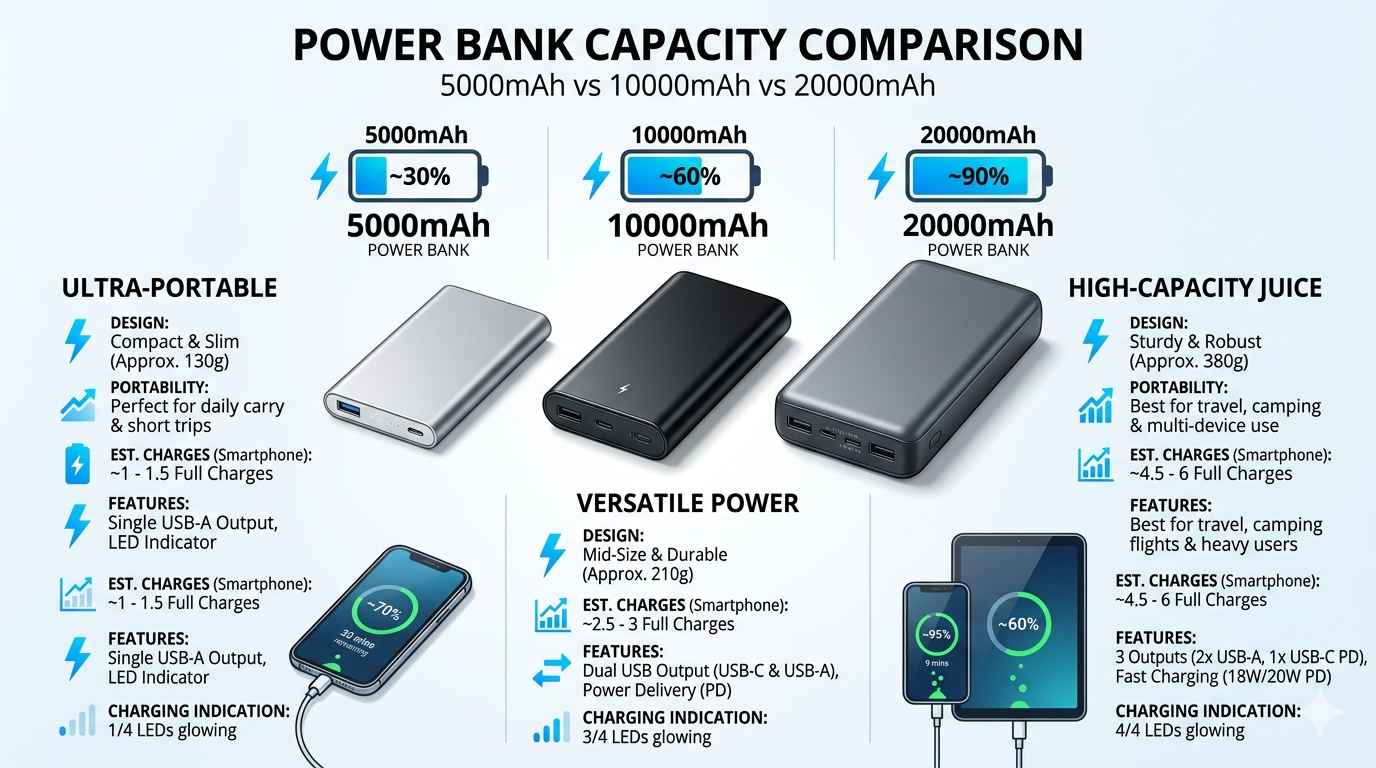
The answer depends on your lifestyle.
Choose 5000mAh If:
- You only need emergency backup
- You rarely run out of battery
Choose 10000mAh If:
- You need daily backup
- You want portability
- You use one smartphone
Choose 20000mAh If:
- You travel frequently
- You charge multiple devices
- You spend long hours away from charging points
For most users, a 10000mAh power bank offers the best balance between portability and battery backup.
Common Myths About Power Bank Capacity
Bigger Capacity Always Means Better
Not necessarily.
A 20000mAh power bank provides more backup, but it is also heavier and less convenient to carry.
All 10000mAh Power Banks Perform the Same
Battery quality, charging efficiency, and safety features can vary significantly between brands.
Higher mAh Means Faster Charging
Charging speed depends on wattage and charging technology, not capacity alone.
FIND A PERFECT CHOICE FOR YOU AND BUY WITHOUT DELAY ;
>>> YOU CAN BUY OF YOUR OWN CHOICE <<<
Final Thoughts
Understanding power bank capacity is much easier once you know what mAh actually means.
The number simply tells you how much energy the power bank can store. Larger capacities provide more backup, but they also increase size, weight, and charging time.
For most people, a 10000mAh power bank remains the best choice because it offers a practical balance between portability and performance. If you travel often or need backup for multiple devices, a 20000mAh model may be worth the extra investment.
Before buying a power bank, focus on your actual needs rather than simply choosing the biggest number on the box.
A power bank that matches your lifestyle will always be a better purchase than one that looks impressive on paper.
Frequently Asked Questions
What does mAh mean in a power bank?
mAh stands for milliampere-hour and measures how much energy a battery can store.
Is 10000mAh enough for daily use?
Yes. For most smartphone users, a 10000mAh power bank provides enough backup for daily use.
How many times can a 20000mAh power bank charge a phone?
A 20000mAh power bank can typically charge a modern smartphone around three to four times, depending on battery size and efficiency.
Does higher mAh mean faster charging?
No. Charging speed depends on wattage and charging technology, while mAh measures battery capacity.
Which power bank capacity is best?
For most people, 10000mAh offers the best balance between portability and battery backup.


